Customisation Notes of Printed Decorative Paper Patterns
Datetime:2026-6-24From: originalClick:7
Summary | What you need to know before commissioning custom printed decorative paper, from design specifications to production practicalities.
Commissioning a custom printed decorative paper pattern is one of those things that sounds wonderfully creative until you find yourself knee-deep in colour calibration files and minimum order quantities. Done right, it gives you a unique finish that no competitor can replicate. Done wrong, it is an expensive exercise in frustration. Here is what the process actually involves and how to navigate it.
The design phase: more than just a pretty picture
The first thing to understand is that what looks good on a computer screen will not necessarily translate to a 1.25-metre-wide roll of paper. Screen colours are created with light (RGB), whilst printed paper uses ink (CMYK), and the conversion between the two is never perfect. If you have a specific colour in mind — say, a particular shade of sage green for a furniture range — provide a physical sample, not just a digital reference. Pantone codes help, but nothing beats an actual swatch.
Pattern repeat is the technical detail that catches people out. The repeat is the distance between one instance of the pattern and the next identical instance, and it determines how the paper will look when applied across a large surface. A repeat that is too short creates an obviously repetitive, wallpaper-like effect. A repeat that is too long wastes material and increases cost. For most furniture applications, a repeat of 30-60 cm works well, but this depends on the scale of the pattern and the size of the panels it will be applied to.
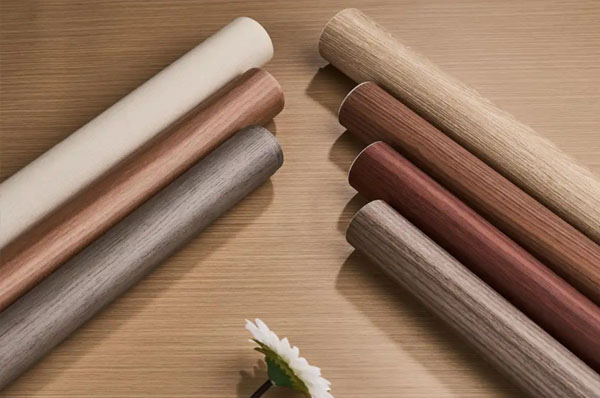
If your design includes a wood grain or other directional pattern, consider the orientation. Most decorative paper is printed with the grain running along the length of the roll, which is fine for vertical applications like doors and panels. For horizontal surfaces, you may want the grain to run across the width, which requires a different print orientation and will affect how the paper is cut and used.
Technical specifications to nail down early
Before the printer starts work, you need to agree on the substrate paper specification. The grammage, opacity, and absorbency all affect how the ink sits on the paper and how the paper behaves during impregnation and pressing. A design that looks crisp and sharp on an 80 g/m² paper may look washed out on a 60 g/m² sheet because the thinner paper absorbs more ink into its structure.
Colour fastness to light should be specified and tested. Ask for accelerated ageing test results using the ISO 105-B02 standard, which measures how the colours hold up under simulated sunlight. A rating of 6 or above on the blue wool scale is generally acceptable for interior applications; anything below 4 means the colours will fade noticeably within a year or two of normal use.
The printing method matters. Gravure printing offers the highest quality and is the standard for high-volume production, but the setup costs are substantial because each colour requires a separate engraved cylinder. Digital printing has lower setup costs and is more flexible for short runs, but the print quality, colour consistency, and light fastness are generally not as good. For a custom pattern that you expect to use for years, gravure is the better investment. For a one-off project or a prototype run, digital may be sufficient.
Minimum order quantities and lead times
Custom decorative paper is not a 'buy a few metres' proposition. Gravure printing typically requires minimum orders in the thousands of square metres, because the cost of engraving the cylinders has to be amortised across the production run. Digital printing can handle smaller quantities, but the per-unit cost is higher. Be realistic about your volume needs before approaching a printer, and ask about minimum order quantities upfront to avoid disappointment.
Lead times vary, but eight to twelve weeks from artwork approval to delivery is typical for a new gravure-printed design. Digital printing can be faster — sometimes as little as two to three weeks. Factor this into your project timeline, and build in a buffer for the inevitable revisions and re-approvals that come with any custom manufacturing process.





 Location: